"How's business going?"
If your answer to this question involves the words "I think," "probably," or "I'd have to check," you don't have a business — you have an expensive hobby with occasional income.
I don't say this to be harsh. I say it because I was exactly this person for two years. I had clients. I was making money. But if you asked me:
- "What's your monthly recurring revenue?"
- "What percentage of your income goes to SaaS subscriptions?"
- "Which client is your most profitable?"
- "How many invoices are overdue right now?"
I would have stared at you blankly and said, "Uh... let me check my bank statement."
That's not financial management. That's financial guessing.
The "Active Clients" Trap
The most common metric solo operators track is number of active clients. It feels productive. "I have 8 active clients right now" sounds like a healthy business.
But it tells you almost nothing about the health of your business. Consider two freelancers:
| Metric | Freelancer A | Freelancer B |
|---|---|---|
| Active clients | 8 | 3 |
| Monthly revenue | ₹1,20,000 | ₹2,80,000 |
| Overdue invoices | ₹85,000 | ₹0 |
| Monthly SaaS spend | ₹8,500 | ₹2,500 |
| Hours worked/week | 55 | 30 |
Freelancer A has more clients but is working 55-hour weeks, has ₹85,000 in overdue invoices (cash flow crisis), and is spending ₹8,500/month on tools. Freelancer B has fewer clients but higher revenue, zero overdue invoices, lower overhead, and works 30-hour weeks.
Active client count is a vanity metric. The real metrics are financial.
The 8 Metrics Every Solo Business Needs
After building RunoSO's Finance module and using it to manage my own business for 6+ months, here are the metrics that actually drive decisions:
1. Monthly Recurring Revenue (MRR) vs. One-Time Revenue
What it is: Break your income into two buckets:
- Recurring: Retainer clients, maintenance contracts, SaaS subscription income. Predictable.
- One-time: Project-based work, consulting gigs, product sales. Unpredictable.
Why it matters: A business with ₹1,50,000/month in revenue sounds healthy. But if ₹1,40,000 of that is a single project payment and ₹10,000 is recurring, you have a 2-month runway at best. When that project ends, you're scrambling.
Target: Aim for at least 40% of revenue from recurring sources. Retainer agreements, monthly maintenance packages, and subscription-based services build a stable foundation.
How to track it: In RunoSO, every transaction is categorized as income or expense, and linked to a client. I can filter by client to see which relationships are recurring vs. one-time.
2. Outstanding Receivables (Unpaid Invoices)
What it is: The total amount your clients owe you right now — invoices that are "Sent" but not "Paid."
Why it matters: Outstanding receivables are not revenue. You can't pay your hosting bill with an unpaid invoice. High receivables mean:
- Cash flow problems (you did the work but haven't been paid).
- Potential write-offs (clients who never pay).
- A need for better payment terms or upfront advances.
Target: Keep outstanding receivables below 15% of your monthly revenue. If you invoiced ₹2,00,000 last month, you should have no more than ₹30,000 unpaid.
How to track it: RunoSO's invoice system shows Sent and Overdue invoices on the Dashboard with their total value. One glance tells you how much you're owed.
3. Average Invoice Turnaround Time
What it is: The average number of days between sending an invoice and receiving payment.
Why it matters: If your average turnaround is 45 days, you're effectively lending money to your clients interest-free for 6 weeks. A 15-day turnaround means faster cash flow and less stress.
Target: Under 15 days. Achieve this with:
- Net-15 payment terms (not Net-30).
- Advance payments (30–50% upfront).
- Automated payment reminders.
- Offering UPI/bank transfer for instant payments.
How to track it: Compare invoice issue dates to payment received dates in your transaction log.
4. Client Profitability
What it is: Revenue received from a client minus all expenses incurred for their work.
Why it matters: Not all clients are created equal. Some clients generate ₹1,00,000 in revenue but require ₹40,000 in hosting, software, and contractor costs. Others generate ₹50,000 with ₹5,000 in expenses. The second client is actually more profitable.
Target: Know the profitability of your top 5 clients. If any client's profitability is below 50%, either raise rates or reduce scope.
How to track it: In RunoSO, both invoices and expenses link to clients. The Finance dashboard can show revenue vs. expenses per client.
5. Expense Ratio (Monthly Overhead ÷ Revenue)
What it is: What percentage of your revenue goes to running your business?
Why it matters: If you're making ₹2,00,000/month but spending ₹80,000 on hosting, SaaS tools, contractor payments, and office rent, your effective take-home is ₹1,20,000. That 40% expense ratio is dangerously high for a solo operation.
Target: Keep your expense ratio below 20%. Solo operators should be lean. Your biggest expense should be time, not tools.
How to track it: Log every business expense in RunoSO's transaction tracker. The Finance dashboard shows total income vs. total expenses with a clear ratio.
6. Monthly Revenue Trend (3-Month Rolling Average)
What it is: Your average monthly revenue over the last 3 months.
Why it matters: Individual months can be spiky. You might have a ₹5,00,000 month (big project payment) followed by a ₹50,000 month (gap between projects). The 3-month rolling average smooths out the noise and shows you the real trajectory.
Questions to ask:
- Is the trend going up, down, or flat?
- If it's flat, are you comfortable at this level?
- If it's going down, what changed? Lost a client? Fewer leads?
How to track it: RunoSO's Finance overview shows monthly revenue charts powered by Recharts. Visual trends are easier to spot than raw numbers.
7. Investment Performance
What it is: The return on your personal investments — stocks, SIPs, crypto, fixed deposits.
Why it matters: As a solo operator, your business income and personal wealth are deeply intertwined. If your business generates surplus cash, investing it wisely creates a financial buffer. Tracking investments alongside business finances gives you a complete picture of your financial health.
Why most freelancers ignore this: Because their "investment tracking" lives in a separate app (Groww, Zerodha, etc.) that has nothing to do with their business tools. They see business finances in one silo and investments in another, so they never connect the dots.
How RunoSO helps: The Investments module tracks stocks, SIPs, crypto, and FDs alongside your business income and expenses. Same dashboard. Same login. Complete financial visibility.
8. Capacity Utilization
What it is: What percentage of your available working hours are billed to paying clients?
Why it matters: If you work 40 hours/week but only 25 of those are billable client work, your utilization is 62.5%. The other 37.5% is admin, marketing, sales, learning, and overhead.
Target: Aim for 60–70% utilization. Going above 80% means you have no time for marketing, learning, or rest — leading to burnout. Below 50% means you need more clients or more efficient operations.
How to track it: While RunoSO doesn't have a time tracker (yet), the combination of task completion data and project deadlines gives a rough proxy for how loaded your schedule is.
Building Your Financial Dashboard
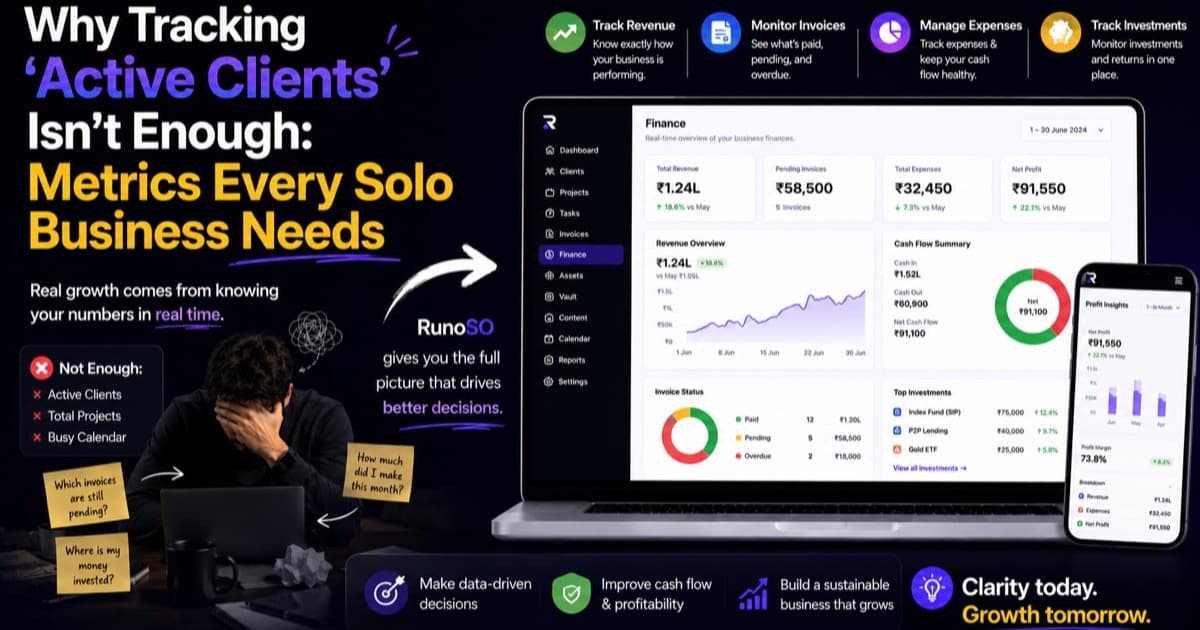
Here's the dashboard view I check every Monday morning in RunoSO:
┌────────────────────────────────────────────────────────────────┐
│  📊 Financial Overview                                        │
│                                                                │
│  Revenue This Month: ₹2,45,000     Expenses: ₹38,500         │
│  Outstanding:         ₹55,000      Overdue:   ₹15,000         │
│  Expense Ratio:       15.7%        Net Profit: ₹2,06,500     │
│                                                                │
│  ┌─ Revenue Trend (Last 6 Months) ─────────────────────────┐  │
│  │    ╭─╮                                                   │  │
│  │   ╭╯ ╰─╮     ╭───╮                                      │  │
│  │  ╭╯    ╰╮   ╭╯   ╰╮  ╭─╮                               │  │
│  │ ╭╯      ╰╮ ╭╯     ╰╮╭╯ ╰──                             │  │
│  │ Jan  Feb  Mar  Apr  May  Jun                             │  │
│  └─────────────────────────────────────────────────────────┘  │
│                                                                │
│  🔴 Overdue Invoices:                                         │
│     INV-025-018  Acme Corp       ₹15,000  (12 days overdue)  │
│                                                                │
│  📈 Top Clients by Revenue:                                   │
│     1. TechStart Pvt Ltd    ₹4,20,000 (YTD)                  │
│     2. Acme Corp            ₹2,80,000 (YTD)                  │
│     3. DesignHub Agency     ₹1,95,000 (YTD)                  │
└────────────────────────────────────────────────────────────────┘
5 minutes every Monday. That's all it takes to know exactly where your business stands.
The "I'll Check Later" Problem
The reason most freelancers don't track these metrics isn't laziness — it's friction. When your financial data lives in spreadsheets, bank apps, and invoicing tools that don't talk to each other, checking your numbers means:
- Log into bank account. Export statement.
- Open Google Sheet. Manually update income/expense rows.
- Open invoicing app. Check which invoices are unpaid.
- Open investment app. Note current portfolio value.
- Do mental math to calculate profitability.
That's 30–45 minutes. So you tell yourself, "I'll check later." Later becomes next week. Next week becomes next month. Next month becomes tax season, when your CA is screaming at you for data.
The solution is a unified dashboard where all of this is visible at a glance. No exports. No manual reconciliation. No "I'll check later."
What to Do This Week
If you're currently flying blind, here are three actions you can take today:
1. Calculate Your Expense Ratio
Open your bank statement. Add up all business-related expenses from last month. Divide by your total income. If it's above 25%, you have a problem worth solving.
2. Check Your Outstanding Invoices
How much are your clients owed? Is any of it more than 30 days overdue? Follow up today.
3. Identify Your Most Profitable Client
For your top 3 clients, calculate: Revenue received - Expenses incurred = Profit. You might be surprised which client is actually most profitable.
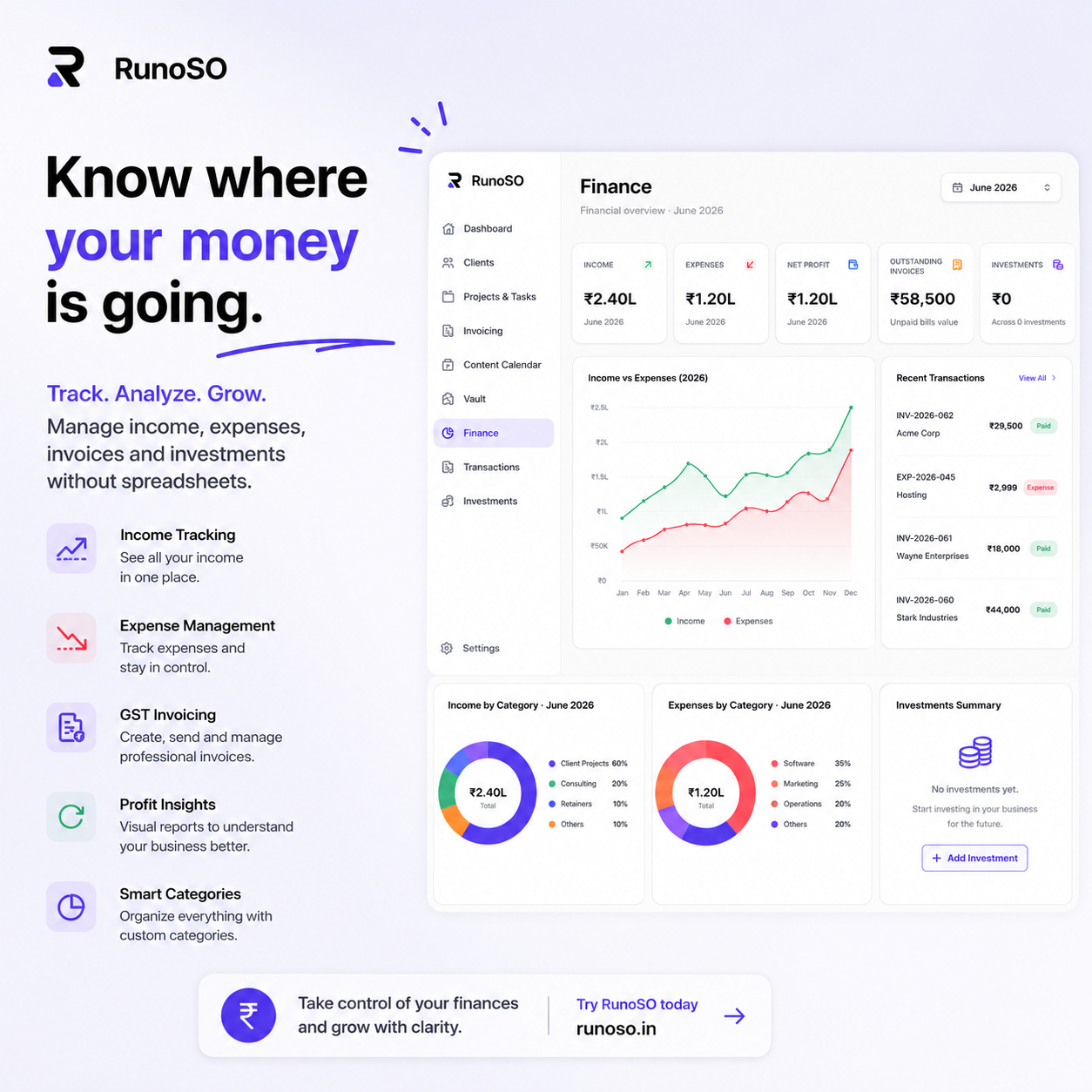
RunoSO's Finance module gives you real-time visibility into revenue, expenses, outstanding invoices, investment performance, and client profitability — all from a single dashboard.
What metrics do you track for your solo business? Share your approach on X (Twitter) — I'm always looking to learn from other operators.
Keep Reading
- Go deeper: track freelance income & expenses.
- Don’t lose domains: digital assets & renewals guide.
- Live dashboards: pricing & features.