Let me paint you a picture.
It's a Tuesday evening. I've got a client breathing down my neck for an invoice I was supposed to send three days ago. I open Google Sheets, scroll through a messy spreadsheet looking for their GSTIN and billing details. I find the number — but wait, it's from the old company name. I hop over to Notion to dig through a page I made six months ago. After fifteen minutes of searching, I find the updated details in a random Slack DM.
Now I need to generate the actual invoice. I open Zoho, realize I'm on the free tier and can't customize the tax line the way I want. I export a janky PDF anyway, paste the client's details in manually, attach it to an email, and hit send.
That was 40 minutes of my life. For one invoice.
And this wasn't even the worst part of my day.
The Hidden Tax of Being a Solo Operator
When you run a solo business — freelancing, consulting, building products — nobody warns you about the admin overhead. Not the coding. Not the design work. Not even the sales calls. It's the in-between work that silently kills your momentum:
- Finding a password you saved "somewhere" — was it in Apple Notes? A
.envfile? That Notion page titled "Misc Credentials"? - Checking when a domain expires — logging into GoDaddy, Namecheap, and Cloudflare one by one.
- Tracking which client owes you money — scrolling through a Google Sheet that somehow has three different tabs for the same client.
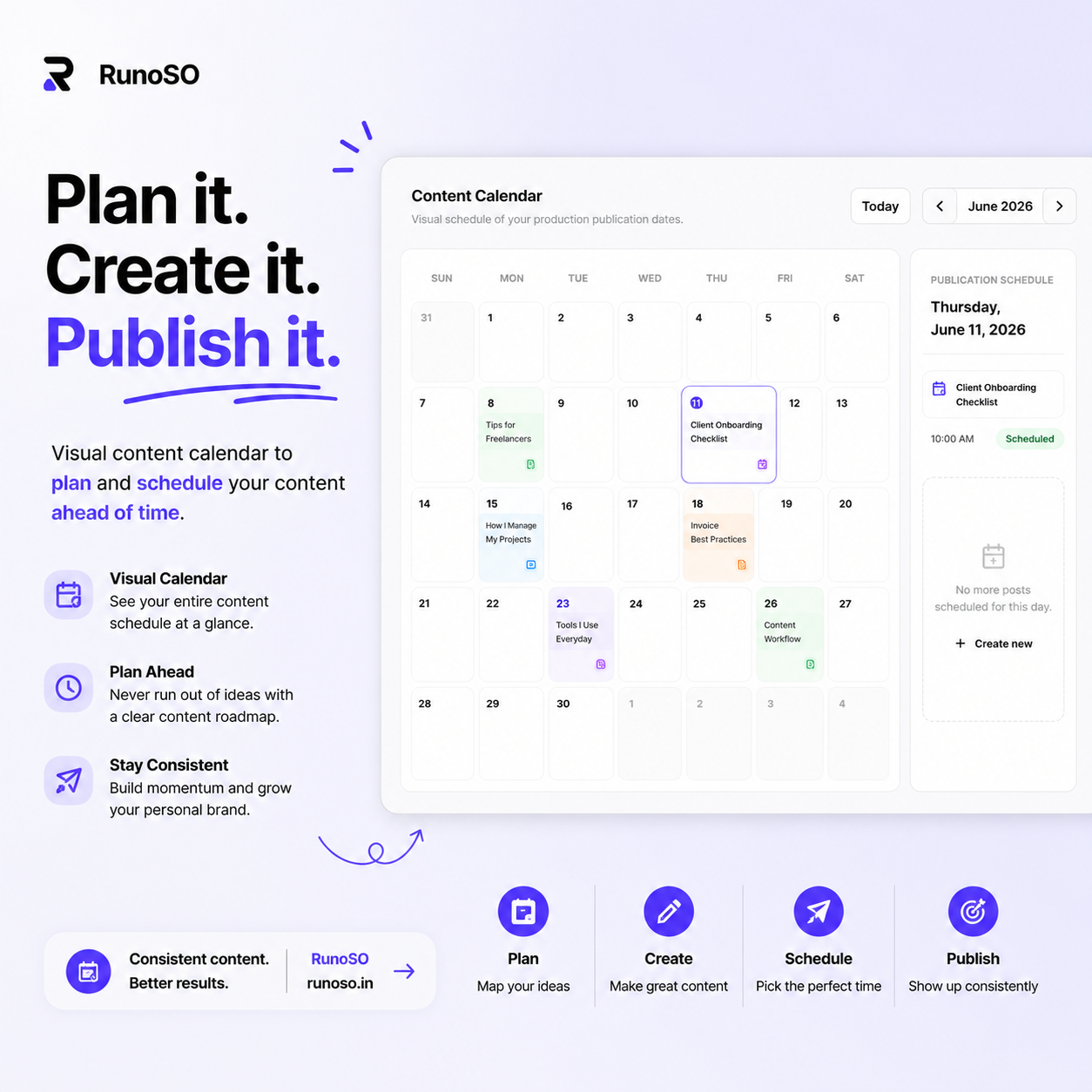
- Remembering what content you were supposed to publish — was it on the Trello board? The sticky note? The voice memo from last Thursday?
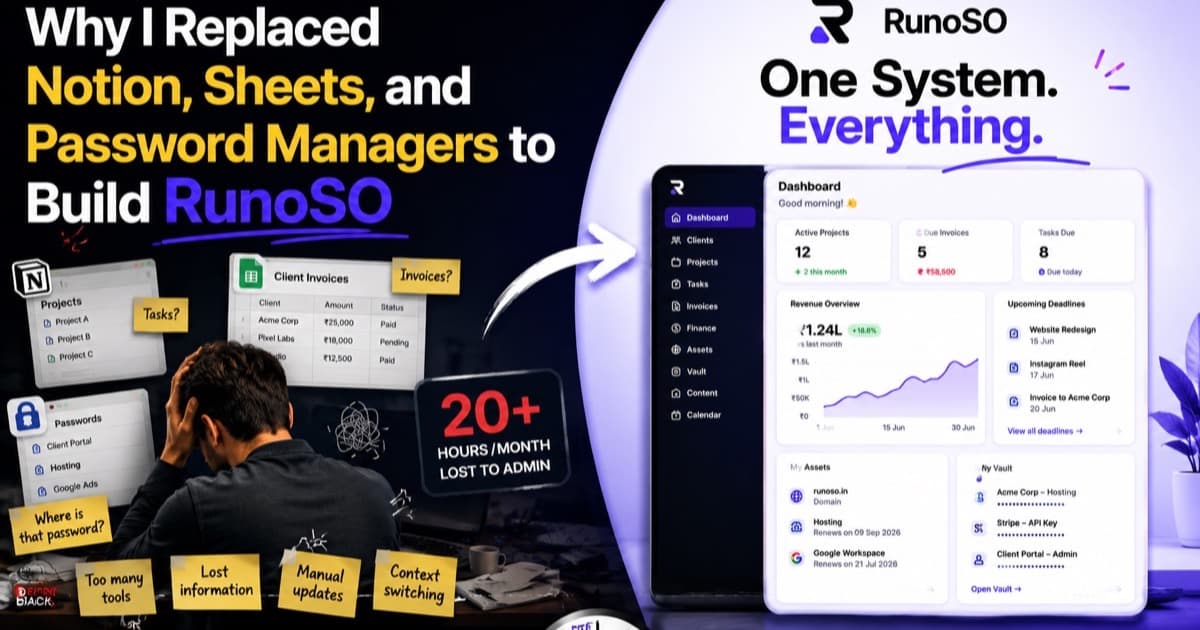
I tallied it up one month. I was spending roughly 18–22 hours per month on pure administrative friction. Not building. Not shipping. Not growing. Just... managing the mess.
The Scattered Tools Problem
Here's what my "tech stack for running a business" looked like before RunoSO:
| Task | Tool | Monthly Cost |
|---|---|---|
| Project Management | Trello (Free) + Notion ($10) | $10 |
| Client CRM | Google Sheets (Free) | $0 |
| Invoicing | Zoho Invoice ($15) | $15 |
| Expense Tracking | Splitwise + Sheets | $0 |
| Password Management | Bitwarden ($10) | $10 |
| Domain/Asset Tracking | Spreadsheet | $0 |
| Content Calendar | Notion + Buffer ($15) | $15 |
| Total | 7 tools, 4 logins | ~$50/month |
$50 doesn't sound like much. But here's the real cost: context switching.
Every time I jumped from Trello to Sheets to Notion to Zoho, I lost focus. Studies show that after a context switch, it takes an average of 23 minutes to return to the same level of deep focus. When you're switching tools 15–20 times a day, you're not running a business — you're running an obstacle course.
The Moment I Said "Enough"
It happened on a Sunday night in November 2024. I was preparing for a Monday morning client call, and I needed three things:
- The project status and remaining budget.
- The server credentials for their staging environment.
- A list of pending invoices.
These three pieces of information lived in three different tools, behind three different logins. None of them talked to each other.
I stared at my screen and thought: "I'm a full-stack developer. I build tools for other people every single day. Why am I tolerating this chaos in my own business?"
That night, I opened a fresh Next.js project and started writing the schema for what would become RunoSO.
What I Actually Built
RunoSO isn't a "productivity app." It's a personal business operating system — a single dashboard where every aspect of running a solo business connects to everything else.
Clients Are the Center of Everything
In RunoSO, a client isn't just a name in a contact list. It's a node that links to:
- Their projects (with budgets, deadlines, and GitHub repos).
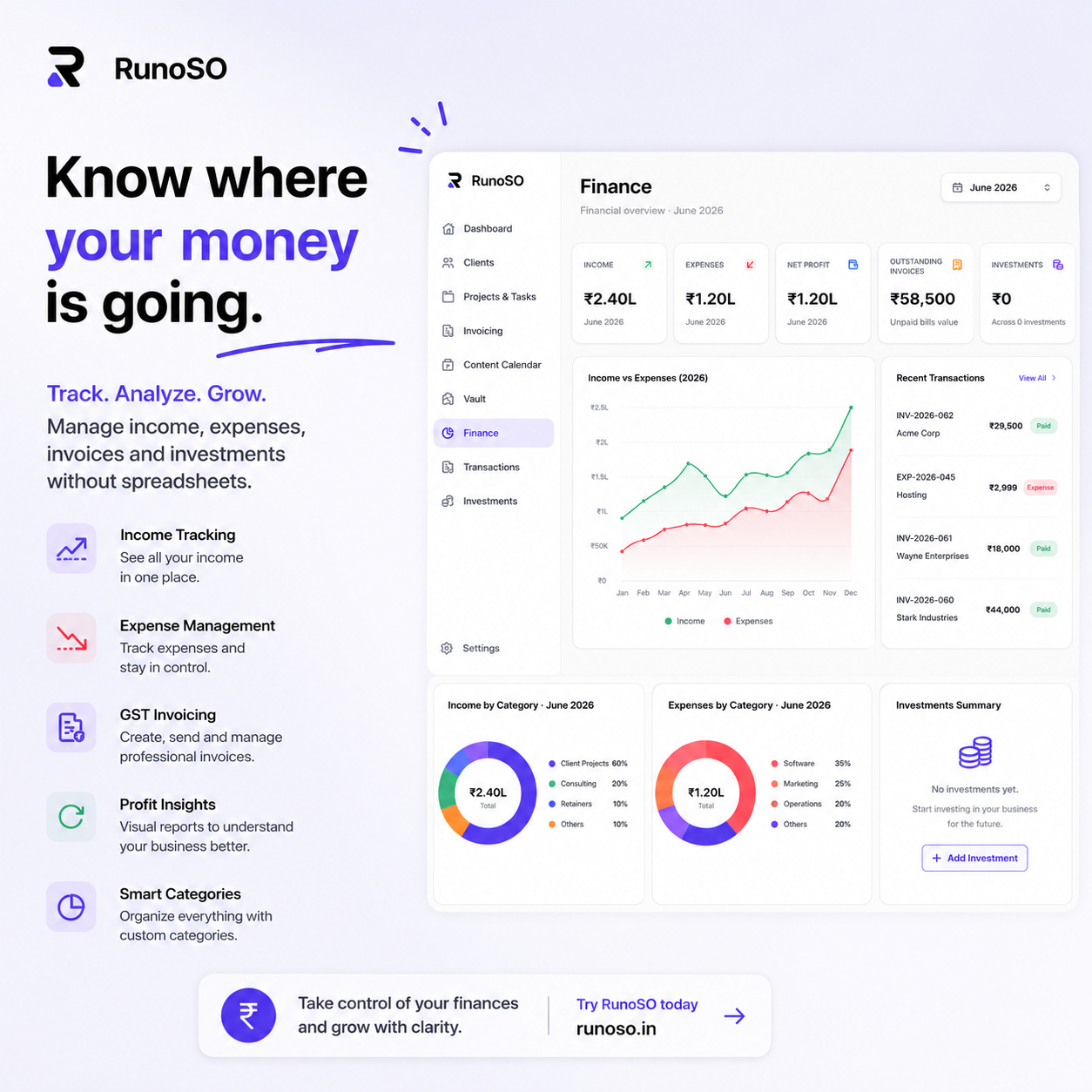
- Their invoices (with auto-calculated taxes, line items, and PDF exports).
- Their transactions (income received, expenses incurred).
- Their vault credentials (server passwords, API keys, hosting details — all AES-256 encrypted).
- Their content (if I'm managing social media or video production for them).
When I open a client page, I see everything. No tab-hopping. No spreadsheet hunting. No Slack searching.
The Vault Changed Everything
This was the feature that made the biggest difference to my sanity. Before RunoSO, I had client server credentials in:
- A
.txtfile on my desktop (I know, I know). - Notion pages with "hidden" toggle blocks (not encrypted, just hidden).
- Shared Google Docs (horrifying in retrospect).
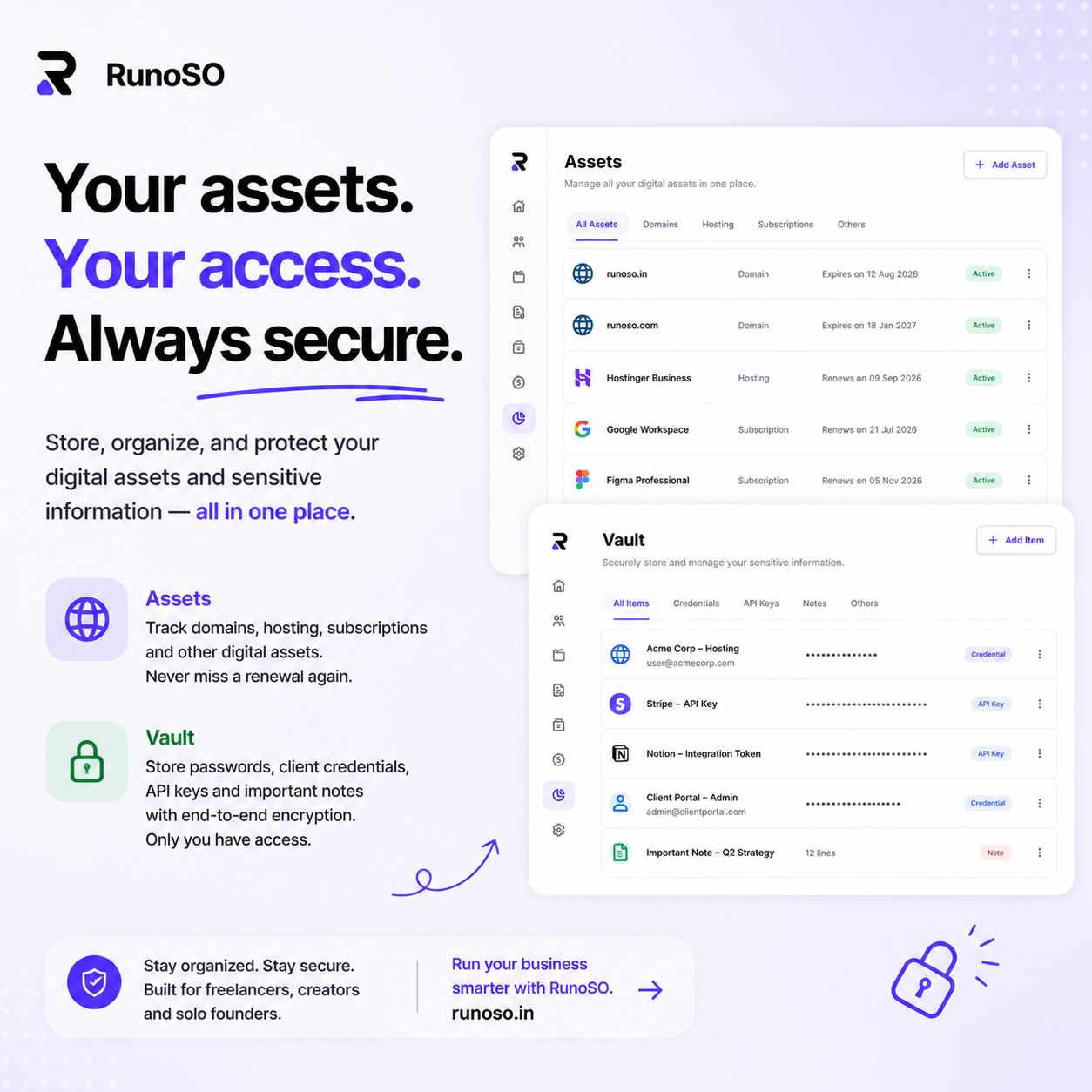
Now, every credential goes into the Vault. It's encrypted with AES-256 using CryptoJS before it even hits the database. The master key never leaves the server. I can store passwords, SSH keys, API tokens, and server IPs — all organized by client and project.
The peace of mind alone was worth building the entire product.
Invoicing Without the Pain
I'm based in India, so invoicing means dealing with GSTIN, PAN numbers, SAC/HSN codes, and CGST/SGST splits. Most invoicing tools either don't support Indian tax formats or charge a premium for them.
RunoSO's invoicing system:
- Auto-populates my business details (name, address, GSTIN, PAN) from Settings.
- Lets me add line items with quantities, rates, and tax percentages.
- Generates clean, branded PDF invoices using jsPDF + html2canvas.
- Tracks status: Draft → Sent → Paid → Overdue.
- Links every invoice to a client and project automatically.
What used to take 40 minutes now takes 90 seconds.
Digital Assets: Never Miss a Renewal Again
I manage around 15 domains, 4 hosting servers, and a handful of Cloudflare zones. Before RunoSO, I'd discover a domain had expired when a client emailed me saying their site was down.
The Digital Asset Manager tracks:
- Domains: Registrar, expiry date, DNS provider, auto-renewal status.
- Hosting/Servers: Provider, IP, plan, monthly cost, renewal date.
- Cloudflare Zones: Linked to domains for quick reference.
- GitHub Repos: Tech stack, visibility, and project links.
- SaaS Subscriptions: Every tool I pay for, its billing cycle, and its cost.
It's like having a control room for your entire digital infrastructure.
Task Streaks: Gamifying the Grind
Freelancing can feel isolating. There's no manager giving you feedback, no team celebrating wins, no dopamine hit from a standup meeting.
So I built Task Streaks — a simple gamification layer that tracks how many consecutive days you complete all your tasks. It shows your current streak, longest streak, and total completed tasks.
It sounds trivial, but it genuinely works. On days when motivation is low, seeing "🔥 14-day streak" on my dashboard is enough to push me through one more productive day.
The Real ROI
After six months of using RunoSO as my daily driver, here's what changed:
| Metric | Before | After |
|---|---|---|
| Monthly admin hours | 18–22 hrs | ~4 hrs |
| Average invoice creation time | 35–40 min | 90 seconds |
| Missed domain renewals | 2–3/year | 0 |
| Credential security incidents | "Let's not talk about it" | 0 (AES-256 encrypted) |
| Tools I pay for | 6–7 subscriptions | 1 (RunoSO) |
But the numbers don't capture the feeling. It's the feeling of opening one tab in the morning and having everything right there. No friction. No context switching. No hunting.
Just focus.
Should You Build Your Own?
Honestly? Probably not. Building RunoSO took months of evenings and weekends. The database has 26 tables. The codebase spans client management, project tracking, invoicing with PDF exports, AES encryption, Stripe billing, content pipelines, and a full digital asset manager.
That's exactly why I'm releasing it as a product. So you don't have to build it yourself.
If you're a freelancer, solopreneur, or small agency founder drowning in scattered tools and admin overhead — RunoSO was built for you, by someone who felt the exact same pain.
This is Part 1 of my "Build in Public" series. Next up: "From Full-Stack Dev to Solo Founder: My Blueprint for Building a Compounding System."
Follow me on X (Twitter) for real-time updates on the journey.
Keep Reading
- Explore the full toolkit on our features page — especially the zero-knowledge vault.
- Learn how to organize your freelance business in one connected system.
- See why most productivity tools break at scale.